AI agent safety oversight frameworks in 2026 have moved well past whitepaper territory — builders are now stress-testing them against production systems that execute code, call external APIs, and operate across multi-agent pipelines with minimal human checkpoints. The gap between a framework that sounds reasonable and one that holds under real conditions is significant.
This piece cuts through the noise to examine the structural approaches that have demonstrated measurable effectiveness: layered guardrail architectures, interrupt-and-audit patterns, sandboxed execution environments, and policy-enforced action scopes. Each framework is evaluated against the failure modes it actually addresses — not the ones it was designed to address on paper.
If you are building or deploying autonomous agents at any scale, the design decisions you make around safety are not optional additions. They are load-bearing architecture. Understanding which frameworks map to which risk profiles is the technically grounded starting point this article aims to provide.
Layered Guardrail Architectures: Defense in Depth for Autonomous Agents

🔧 Related tools & reading:
📘 Designing Machine Learning Systems by Chip Huyen (Audiobook) — $13.00 at Audiobooks.com
🐍 Designing Machine Learning Systems with Python — $41.99 at Barnes & Noble
🛡️ Machine Learning System Design — $43.99 at PressReader
The single-layer prompt filter is dead, or at least it should be. Early deployments treated safety as a bolt-on — a system prompt telling the agent to “be helpful and avoid harm,” perhaps paired with a content moderation API downstream. That architecture fails the moment an agent operates across multiple tool calls, retrieves external data, or spawns subagents. The attack surface is not a single input; it is the entire execution graph. Serious practitioners building ai agent safety oversight frameworks in 2026 are moving toward layered architectures where controls operate at every distinct stratum of agent behavior: input validation, planning-time constraints, tool-call authorization, output filtering, and post-hoc audit logging treated as a first-class system component rather than an afterthought.
What makes the layered model work is that each layer carries independent failure semantics. An input sanitization layer that scrubs prompt injection attempts does not help you if a retrieval-augmented step later injects adversarial content from a third-party document — which is why planning-time constraint evaluation needs to reason about retrieved context, not just user-supplied text. Tool-call authorization deserves particular attention: most dangerous agent behaviors emerge not from what an agent says but from what it does. Implementing a capability manifest — a formally defined set of permissioned actions scoped to a session, a role, and an environmental context — turns “the agent shouldn’t do that” from a vague hope into an enforceable policy. Think of it as the principle of least privilege applied to agentic execution, which is not a novel idea in security engineering, just an underused one in this domain.
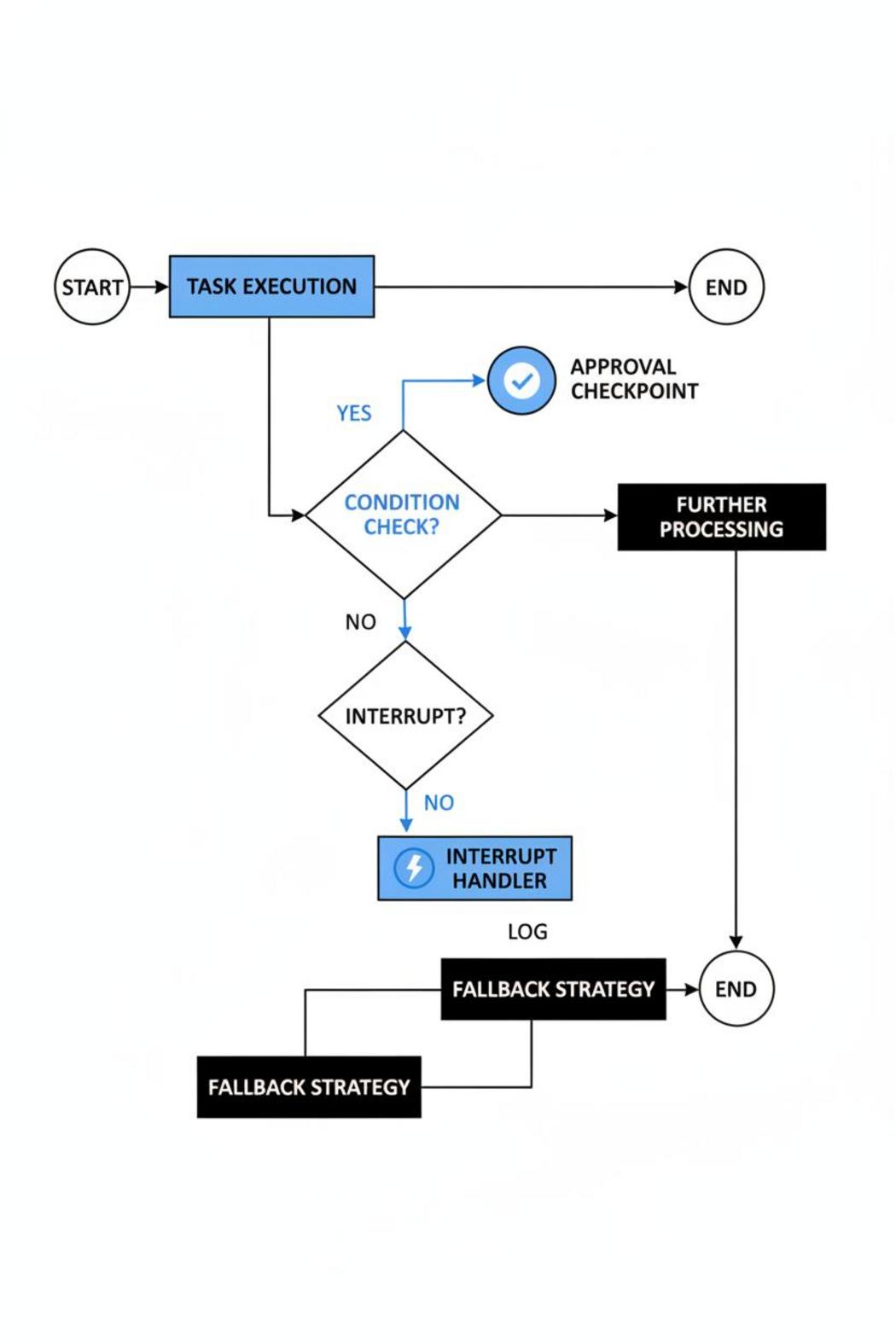
Human-in-the-loop integration is frequently misunderstood as simply inserting approval steps, but its real value in a layered architecture is as a selective interrupt mechanism. The goal is not to require human confirmation for every action — that negates the utility of autonomy — but to define confidence thresholds and irreversibility boundaries at which the agent pauses and escalates. An agent deleting a row from a staging database should probably proceed autonomously. The same agent deleting records from a production customer table should surface that action for explicit authorization regardless of how confident the planning module is. Formalizing the distinction between recoverable and unrecoverable actions is one of the more practically useful things a safety-by-design methodology can contribute to deployment architecture.
The honest caveat is that layered guardrails do not compose automatically — they require deliberate integration work, and poorly integrated layers can conflict, generating false positives that degrade performance or false negatives that create illusory confidence. Autonomous agent risk does not disappear because controls exist at multiple levels; it shifts toward the interfaces between those levels. Teams that treat safety architecture as a continuous engineering discipline, with defined ownership, regression testing, and red-teaming exercises, consistently outperform those who deploy a stack of guardrails at launch and consider the problem solved. Defense in depth is a posture, not a product.
Human-in-the-Loop Patterns That Scale Without Becoming Bottlenecks
🔧 Related tools & reading:
📘 Designing Machine Learning Systems by Chip Huyen (Audiobook) — $13.00 at Audiobooks.com
🐍 Designing Machine Learning Systems with Python — $41.99 at Barnes & Noble
🛡️ Machine Learning System Design — $43.99 at PressReader
The phrase “human-in-the-loop” has been stretched so far that it now covers everything from a human approving every agent action to a human glancing at a weekly summary report. Neither extreme is useful. The former collapses into a bottleneck that negates any efficiency gain from deploying agents in the first place; the latter is oversight in name only. What actually works in production sits somewhere more nuanced: conditional escalation architectures that route decisions to human reviewers based on risk signal, not on action type or frequency alone.
The most durable implementations we’ve seen treat human review as a resource to be allocated intelligently rather than a gate applied uniformly. Agents are instrumented to emit confidence scores, anomaly flags, and context-delta markers — signals that indicate when a planned action deviates meaningfully from prior approved behavior. When those signals cross calibrated thresholds, the agent pauses and surfaces a structured decision packet to a human reviewer. Below threshold, execution continues autonomously with full audit logging. This is where ai agent safety oversight frameworks in 2026 are converging: not on blanket approval workflows, but on dynamic risk-weighted escalation.
Critically, the thresholds themselves need governance. Static thresholds decay fast — what felt cautious at deployment becomes either over-sensitive or dangerously permissive as task distributions shift. The better-designed systems treat threshold calibration as a continuous process, using outcome data from both escalated and non-escalated decisions to tighten or relax boundaries. This feedback loop is what separates a safety architecture from a safety theater installation. It also requires that organizations maintain meaningful human reviewer capacity — people who understand agent behavior well enough to make real decisions, not just rubber-stamp queues.
There’s also a structural insight worth stating plainly: autonomous agent risk doesn’t scale linearly with autonomy level. A narrow agent doing one well-defined task at high volume is often safer with lighter oversight than a general-purpose agent doing low-volume but highly variable tasks. Oversight architecture should reflect that distinction. Pooling all agents into a single review process misallocates human attention and creates the exact bottleneck that makes safety feel like an obstacle to deployment rather than a design property. Safety by design, at the agent architecture level, means matching oversight intensity to actual variance and consequence — not applying a single policy across heterogeneous agent populations.
The teams that have figured this out share one characteristic: they instrumented heavily before they automated broadly. You cannot tune escalation logic you cannot observe, and you cannot defend an oversight model you cannot explain to a regulator or a stakeholder when something goes wrong. The technical infrastructure — structured logging, policy-as-code guardrails, reviewer tooling with context injection — is unglamorous work, but it’s the difference between a scalable oversight model and one that either breaks under load or quietly stops catching anything meaningful.
Sandboxed Execution and Action Scope: Containing Autonomous Agent Risk

🔧 Related tools & reading:
📘 Designing Machine Learning Systems by Chip Huyen (Audiobook) — $13.00 at Audiobooks.com
🐍 Designing Machine Learning Systems with Python — $41.99 at Barnes & Noble
🛡️ Machine Learning System Design — $43.99 at PressReader
The most operationally mature approach to autonomous agent risk isn’t better prompting or smarter models — it’s architectural containment. Sandboxed execution environments force agents to operate within explicitly bounded action spaces, meaning that even if an agent’s reasoning goes sideways, the blast radius is structurally limited before a single line of consequential code runs. This is safety by design in its most literal form: the system’s architecture enforces constraints that no runtime monitor can reliably replicate after the fact.
What makes modern sandboxing genuinely effective — as opposed to theatrical — is the combination of capability restriction with observable state. An agent executing inside a properly scoped environment doesn’t just lack the permission to write to a production database or initiate an external API call; it lacks the surface area entirely. The distinction matters enormously. Permission-based controls can be bypassed through prompt injection, tool misuse, or multi-step reasoning chains that individually look benign. Capability absence cannot. The leading ai agent safety oversight frameworks in 2026 increasingly treat these two concepts as non-interchangeable, and organizations that conflate them are carrying more risk than their security posture reflects.
Action scope definition is the complementary layer. Before deployment, every agent should have a formally specified action vocabulary — a precise enumeration of what it can call, modify, read, and trigger, with any out-of-scope action resulting in a hard stop rather than a graceful degradation. This isn’t just a governance nicety; it creates an auditable contract between the agent’s intended behavior and its runtime capabilities. When that contract is versioned and reviewed, it also becomes the natural anchor point for human-in-the-loop checkpoints, particularly at the boundary between low-stakes reversible actions and high-stakes irreversible ones.
The practical challenge is that action scope tends to erode under product pressure. Teams extend tool access incrementally, often without re-evaluating the cumulative risk profile, until the original containment model is effectively fiction. Robust AI agent guardrails require that scope changes go through the same review cycle as the initial deployment — not because bureaucracy is inherently valuable, but because scope creep is one of the more empirically consistent pathways to real-world agent incidents. Treating sandbox boundaries as living infrastructure, subject to drift and requiring active maintenance, is what separates organizations running serious agentic systems from those running serious-sounding ones.
Safety by Design: Embedding Oversight Into Agent Architecture From the Start

🔧 Related tools & reading:
📘 Designing Machine Learning Systems by Chip Huyen (Audiobook) — $13.00 at Audiobooks.com
🐍 Designing Machine Learning Systems with Python — $41.99 at Barnes & Noble
🛡️ Machine Learning System Design — $43.99 at PressReader
The most persistent mistake in agentic system design is treating safety as a post-deployment concern — something bolted on after the core architecture is already fixed. By that point, the structural decisions that actually determine how controllable a system can become have already been made. Effective ai agent safety oversight frameworks in 2026 don’t look like checklists applied to finished systems; they look like architectural constraints that shape what a system is even capable of doing in the first place.
What this means in practice is that oversight surfaces need to be designed into the agent’s execution graph from day one. This includes clearly defined interruption points where the agent must surface its state and intended next action before proceeding, particularly at decision nodes that involve external writes, resource allocation, or multi-step irreversible sequences. These aren’t optional hooks added for compliance — they are load-bearing structural elements. An agent built without them cannot be meaningfully audited or redirected mid-task, regardless of what monitoring tooling you layer on top afterward.
Closely related is the question of capability scoping. Autonomous agent risk scales non-linearly with tool access, and many current deployments grant agents far broader permissions than any specific task requires. The principle here is straightforward: an agent should not hold credentials it doesn’t need for the current task scope, and its ability to acquire new capabilities at runtime should be explicitly constrained rather than implicitly permitted. This is less about distrust of the model and more about limiting blast radius when — not if — the agent encounters an edge case its developers didn’t anticipate.
Human-in-the-loop mechanisms deserve particular attention here, because the phrase gets used loosely enough to mean almost nothing. A confirmation dialog that defaults to “approve” after three seconds is not meaningful human oversight. Real human-in-the-loop design means identifying the specific decision categories where human judgment provides genuine error-correction value, routing only those decisions to human review, and making the information presented to the reviewer sufficient to actually evaluate the proposed action. Poorly designed review interfaces don’t just fail to catch errors — they create liability by generating a paper trail of approvals that nobody meaningfully made.
AI agent guardrails implemented at the architecture layer also tend to be more robust than those implemented at the prompt layer. Prompt-based constraints can be undermined by sufficiently adversarial inputs or by the model’s own multi-step reasoning across a long context window. Architectural constraints — rate limits, tool call validation schemas, scoped credential stores, enforced confirmation gates — are harder to reason around because they don’t pass through the model at all. This doesn’t eliminate the need for carefully designed system prompts, but it does mean that the structural layer should never be treated as redundant with the prompt layer. They’re doing fundamentally different work, and both need to be present.
Conclusion
AI agent safety oversight frameworks in 2026 are no longer aspirational—they are operational prerequisites. The evidence is clear: layered guardrails, continuous behavioral monitoring, structured human-in-the-loop checkpoints, and auditable decision traces consistently outperform bolt-on compliance approaches in production environments. Teams embedding these constraints at the architecture level ship faster and recover from failures more gracefully. The builders who will ship reliable autonomous systems in 2026 are the ones treating safety oversight as a first-class engineering constraint, not a compliance checkbox bolted on after deployment. Build it in from day one.
Questions or something we should be covering? Reach out via the Contact page. ⚡