Agentic AI enterprise adoption in 2026 has moved decisively past the proof-of-concept phase, with production deployments of multi-step autonomous agents now measurable across finance, logistics, software development, and healthcare operations. Unlike the narrow automation tools that preceded them, enterprise AI agents in this cycle are characterized by persistent memory, tool use, and the ability to decompose ambiguous objectives into executable subtasks without human intervention at each step.
This report draws on deployment patterns, engineering team surveys, and observable infrastructure shifts to map where agentic workflows are delivering quantifiable ROI and where integration friction remains a ceiling on scale. The goal is not to forecast sentiment but to document what is actually running in production, what is failing quietly, and what architectural decisions are separating successful enterprise deployments from stalled pilots.
Where Agentic Workflows Are Actually Running in Production

🔧 Related tools & reading:
🏗️ Designing Large Language Model Applications — $54.44 at Walmart
🏢 LLMs in Enterprise: Design strategies, patterns, and best practices for large language model development — $43.99 at Walmart
⚙️ Managing Production Large Language Models: Playbook for Designing, Deploying, and Operating LLM at Scale and Machine Learning FinOps Blueprints — $11.99 at Audible.com
Despite the volume of announcements and demos that dominated 2025, agentic AI enterprise adoption in 2026 is concentrated in a narrower set of use cases than the hype cycle suggested. The deployments that are actually running in production share a common profile: they operate within bounded, high-frequency workflows where the cost of occasional failure is recoverable, the input data is structured or semi-structured, and there is a clear feedback loop that allows teams to measure output quality. Finance, legal operations, and technical support have emerged as the early production leaders — not because they are the most exciting applications, but because they offered the right combination of task repetitiveness, available ground truth, and organizational tolerance for iterative rollout.
In financial services, the most mature enterprise deployments are handling reconciliation triage, regulatory document summarization, and first-pass contract review at scale. These are not fully autonomous pipelines in most cases. The architecture tends to be human-in-the-loop at decision boundaries, with agents handling the labor-intensive intermediate steps — extraction, classification, cross-referencing — that previously consumed analyst time without adding judgment value. The ROI case for these deployments is straightforward to construct because the baseline is measurable: hours per task, error rates on manual extraction, throughput per analyst. When AI automation ROI is grounded in that kind of operational data, budget conversations become significantly easier.
Software engineering workflows represent the other high-activity zone, though the deployment patterns here are more heterogeneous. Some organizations have integrated agentic systems directly into CI/CD pipelines for test generation and code review triage. Others are running more experimental configurations where agents handle issue triage and documentation updates but are kept outside of anything touching production deployments. The variance in architectural maturity across engineering organizations is wide, and the teams seeing the most consistent value are those that treated enterprise AI agents as infrastructure requiring the same observability tooling they would apply to any other automated system — logging, tracing, failure alerting — rather than as a productivity feature bolted onto existing tooling.
What is notably absent from most credible production reports is the fully autonomous, multi-step reasoning agent operating without meaningful human oversight in high-stakes contexts. The gap between what is technically possible in a controlled demo and what organizations are actually willing to run unsupervised in their core systems remains substantial. Governance concerns, liability questions, and the practical difficulty of validating agent behavior across edge cases have all contributed to a deployment posture that is more conservative than vendor roadmaps implied. That conservatism is not a failure of enterprise AI adoption — it reflects a reasonable calibration of risk by organizations that understand their own operational exposure and have learned, often from early LLM deployments, that moving faster than your evaluation infrastructure can support tends to generate expensive cleanup work downstream.
Infrastructure Patterns Enabling Enterprise-Scale Agent Deployment

🔧 Related tools & reading:
🏗️ Designing Large Language Model Applications — $54.44 at Walmart
🏢 LLMs in Enterprise: Design strategies, patterns, and best practices for large language model development — $43.99 at Walmart
⚙️ Managing Production Large Language Models: Playbook for Designing, Deploying, and Operating LLM at Scale and Machine Learning FinOps Blueprints — $11.99 at Audible.com
The infrastructure conversation around agentic AI enterprise adoption in 2026 has matured considerably from the early “just call an LLM API” architectures that dominated proof-of-concept work in 2023 and 2024. What’s actually working at scale looks less like a single orchestration framework and more like a layered substrate: durable execution engines sitting beneath agent logic, providing the retry semantics, state persistence, and workflow versioning that long-horizon tasks fundamentally require. Platforms like Temporal and Restate have seen meaningful enterprise uptake precisely because they solve the hard problem of what happens when a five-hour agentic workflow encounters a transient failure at step forty-three.
Memory architecture has emerged as a genuine differentiator rather than an afterthought. Enterprise deployments that perform well tend to separate working memory, episodic memory, and semantic retrieval into distinct systems with explicit write policies, rather than stuffing everything into a single vector store and hoping retrieval handles the rest. The teams that have gotten this right are treating agent memory as a data engineering problem, with the same discipline around schema design and access patterns they’d apply to any production database. That shift in framing — from “AI feature” to “data infrastructure” — correlates strongly with the deployments that are actually generating measurable AI automation ROI rather than sitting in perpetual pilot status.
Observability has also crossed a threshold from nice-to-have to deployment prerequisite. The agentic workflows causing the most operational pain in enterprise environments are the ones where no one can reconstruct what a multi-step agent actually did or why it made a specific tool call. Production teams are now demanding span-level tracing across the full agent execution graph, not just LLM call logs. This has pushed vendors to build structured trace formats that capture decision points, tool invocations, and intermediate reasoning states in a way that both engineers and compliance teams can interrogate — a non-trivial design challenge when agent behavior is inherently non-deterministic.
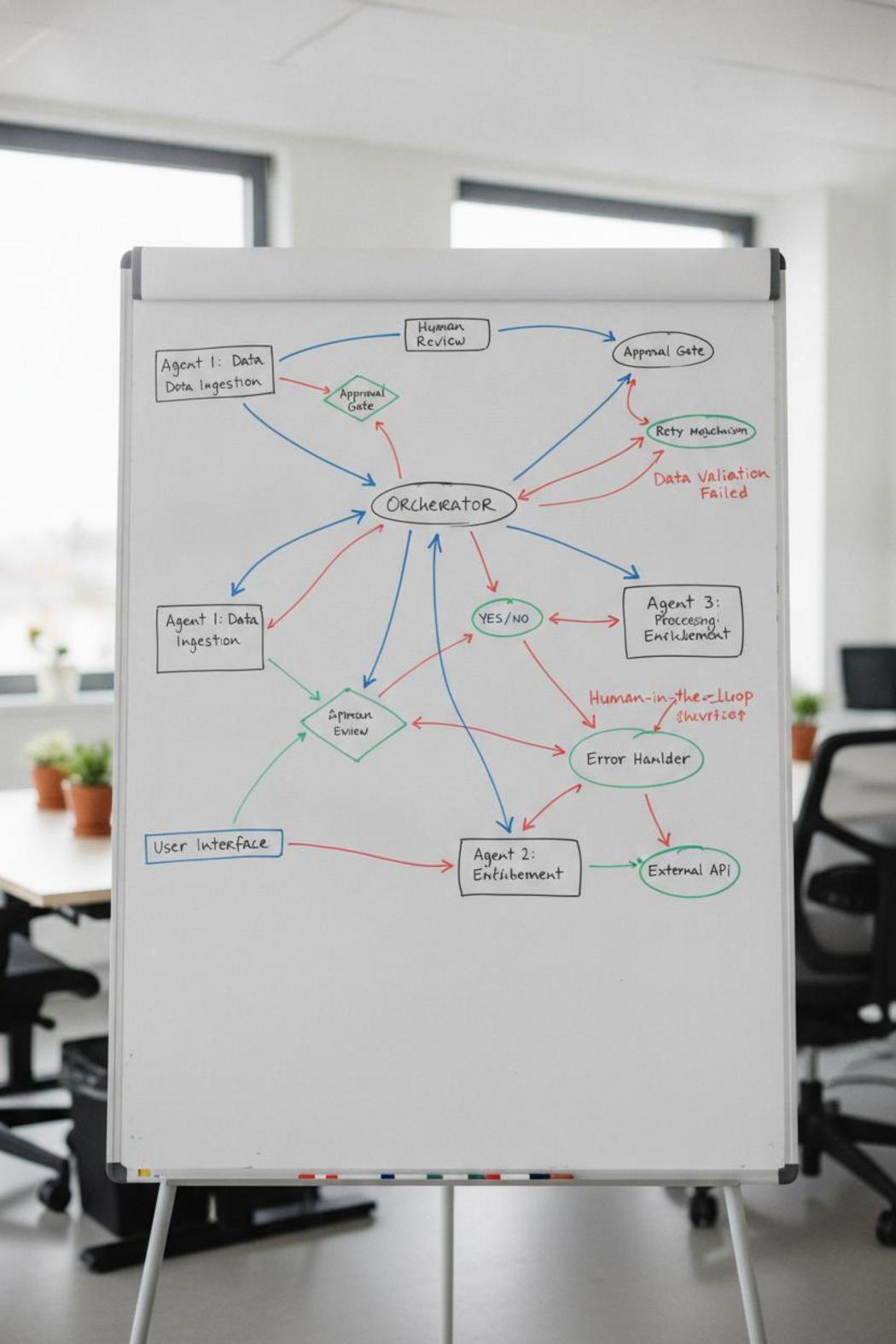
On the deployment topology side, the hub-and-spoke multi-agent patterns that looked elegant in architecture diagrams have often given way to more federated designs in practice. Centralized orchestrator agents create bottlenecks and single points of failure that enterprise infrastructure teams are understandably reluctant to accept. The more resilient pattern emerging in regulated industries involves peer-coordination between specialized agents with explicit message contracts, versioned interfaces, and independent scaling profiles. It’s architecturally closer to microservices than to the monolithic agent pipelines that got the most early attention, and it carries similar operational tradeoffs — more moving parts, but significantly better fault isolation and the kind of incremental deployability that enterprise deployment teams actually need to ship with confidence.
Measuring AI Automation ROI: Metrics Engineering Teams Are Using

🔧 Related tools & reading:
🏗️ Designing Large Language Model Applications — $54.44 at Walmart
🏢 LLMs in Enterprise: Design strategies, patterns, and best practices for large language model development — $43.99 at Walmart
⚙️ Managing Production Large Language Models: Playbook for Designing, Deploying, and Operating LLM at Scale and Machine Learning FinOps Blueprints — $11.99 at Audible.com
Quantifying returns from agentic workflows has become one of the more technically demanding problems engineering and platform teams are navigating in 2026. Unlike traditional software deployments where throughput and latency tell most of the story, enterprise AI agents introduce compounding variables: task completion fidelity, error propagation across multi-step pipelines, and the cost of human review triggered by low-confidence outputs. Teams that are doing this rigorously have moved well beyond simple cost-per-task calculations and are building instrumentation layers that capture the full operational picture.
The metric that keeps surfacing in serious deployments is what some teams are calling “effective automation rate” — not the percentage of tasks an agent attempts, but the percentage it completes correctly without requiring downstream correction or rework. An agent that handles 95% of invoice processing tasks but introduces reconciliation errors in 20% of those completions is not delivering a 95% automation rate in any meaningful financial sense. During agentic AI enterprise adoption in 2026, distinguishing between task initiation rate and verified task closure rate has become a foundational instrumentation requirement, particularly for workflows where errors compound before a human ever sees the output.
Latency-adjusted throughput is another dimension teams are tracking carefully. Agentic workflows often trade wall-clock speed for reduced human labor, which is a reasonable tradeoff — but only if the latency cost doesn’t reintroduce bottlenecks elsewhere in the pipeline. Engineering teams are increasingly instrumenting end-to-end cycle time against baseline human performance rather than against theoretical limits, giving them a more honest comparison for executive reporting. Token consumption per successful task completion has also emerged as a practical cost proxy, especially as organizations running large-scale enterprise deployment discover that poorly scoped agent prompts or redundant tool calls can quietly erode margin even when headline task volumes look strong.
Reliability metrics under distribution shift are where many teams still have significant blind spots. An agent benchmarked on historical data performs well until the underlying document formats, APIs, or business rules change — and in enterprise environments, those changes happen continuously. Forward-looking teams are building regression harnesses that stress-test agents against synthetic edge cases and recent out-of-distribution examples, treating agent reliability more like a software SLO problem than a one-time evaluation exercise. The organizations seeing the clearest AI automation ROI signals are generally those that have closed the feedback loop between production monitoring and re-evaluation pipelines, making measurement a continuous operational function rather than a quarterly reporting ritual.
Failure Modes and Guardrails: What Is Blocking Enterprise Deployment
🔧 Related tools & reading:
🏗️ Designing Large Language Model Applications — $54.44 at Walmart
🏢 LLMs in Enterprise: Design strategies, patterns, and best practices for large language model development — $43.99 at Walmart
⚙️ Managing Production Large Language Models: Playbook for Designing, Deploying, and Operating LLM at Scale and Machine Learning FinOps Blueprints — $11.99 at Audible.com
The gap between proof-of-concept enthusiasm and production-grade deployment is where agentic AI enterprise adoption in 2026 is quietly stalling. Across financial services, healthcare, and logistics, the pattern is consistent: early pilots demonstrate compelling task completion rates, budget gets allocated, and then deployment timelines stretch from quarters into years. The culprit is rarely the underlying model capability. It is the infrastructure around it — specifically, the absence of reliable failure detection, rollback mechanisms, and audit trails granular enough to satisfy both engineering teams and compliance functions.
The failure modes themselves tend to cluster around two categories: action irreversibility and context drift. Enterprise AI agents operating across multi-step workflows frequently encounter decision points where an action — sending a communication, modifying a record, initiating a transaction — cannot be undone once executed. Unlike a chatbot that produces a wrong answer a human can discard, an agentic workflow that takes a wrong turn mid-task can propagate errors downstream before any human supervisor has visibility. Context drift compounds this: agents operating over extended sessions or across tool calls can lose coherent grounding in the original task objective, producing outputs that are locally plausible but globally incoherent. Neither failure mode is exotic. Both are predictable. What is missing in most enterprise deployments is systematic instrumentation to catch them before they reach consequential state.
Guardrail architectures are maturing, but adoption is uneven. The more sophisticated teams are moving toward layered intervention models — combining hard constraints at the tool-call level, confidence-threshold gates that escalate to human review, and session-scoped memory boundaries that reset agent context at defined checkpoints. What distinguishes these approaches from earlier, more rigid rule-based controls is that they are designed to degrade gracefully rather than fail hard, preserving workflow momentum while containing blast radius. The challenge is that building this infrastructure requires meaningful investment in observability tooling that most enterprise AI teams are not yet staffed or budgeted to maintain.
The ROI calculus for AI automation is also shifting the deployment calculus in ways that are not always visible in vendor benchmarks. When enterprises begin accounting for the engineering cost of guardrail development, the compliance review cycles, and the human oversight roles that agentic workflows actually require rather than eliminate, the net automation gain contracts considerably. This is not an argument against deployment — the long-run productivity case for enterprise AI agents remains credible — but it is an argument for more honest scoping at the project initiation stage. Organizations that have made durable progress in 2026 are typically those that defined success around specific, bounded workflow categories rather than broad automation mandates, and that treated failure mode analysis as a first-class engineering deliverable rather than a post-launch concern.
Conclusion
The gap between enterprises that will operationalize agentic AI at scale by end of 2026 and those still cycling through pilots comes down to a small number of infrastructure and governance decisions made right now. Agentic AI enterprise adoption in 2026 is being defined not by who experiments the most, but by who standardizes agent orchestration, establishes clear human-in-the-loop boundaries, and builds observable, auditable pipelines before complexity compounds. The technical foundations you prioritize in the next quarter will determine whether agentic systems become a durable capability or another stalled initiative.
Questions or something we should be covering? Reach out via the Contact page. ⚡