Agentic AI use cases in enterprise 2026 deployments have moved well beyond pilot programs—production systems are now running multi-step, tool-calling agents that close support tickets, reconcile financial data, and coordinate cross-functional workflows without human intervention at each step.
What separates this wave from earlier RPA or simple chatbot automation is the addition of persistent memory, dynamic tool selection, and the ability to recover from partial failures mid-task. Engineering teams are no longer asking whether agentic architectures are viable; they are choosing between orchestration frameworks, debating context-window economics, and instrumenting agents for observability in regulated environments.
This analysis focuses on the use cases that have demonstrated measurable ROI in real deployments—grounded in what infrastructure, latency constraints, and compliance requirements actually allow in 2026, not in vendor roadmap promises.
Autonomous IT Operations and Incident Response

🔧 Related tools & reading:
🤖 Building LLM Powered Applications — $49.99 at Barnes & Noble
🏢 LLMs in Enterprise: Design strategies, patterns, and best practices for large language model development — $50.99 at Surprise Castle
📘 LLM Engineer’s Handbook — $47.99 at Barnes & Noble – NOOK
Among the most operationally mature agentic AI use cases enterprise teams are deploying in 2026, autonomous IT operations stands out for both its technical depth and measurable ROI. The core pattern involves persistent agents with tool access — monitoring dashboards, runbook APIs, ticketing systems, cloud provider CLIs — operating continuously across observability stacks like Datadog, Grafana, and OpenTelemetry pipelines. When an anomaly surfaces, the agent doesn’t just fire an alert into a Slack channel and wait for a human. It begins working the problem: correlating metrics across services, querying recent deployment logs, checking whether a similar incident pattern has occurred before, and in many cases executing a defined remediation action — restarting a pod, rolling back a feature flag, scaling a node group — before a human engineer has even acknowledged the page.
What makes this genuinely different from earlier AIOps tooling is the multi-step reasoning layer. Prior generations of automated remediation were essentially decision trees dressed up with ML classifiers — brittle, narrow, and requiring constant manual upkeep as infrastructure changed. Current agent workflows built on foundation models can reason over unstructured runbooks, synthesize context from multiple data sources simultaneously, and adapt their diagnostic path based on intermediate findings. An agent investigating elevated latency in a payments microservice might pivot mid-investigation when it detects an upstream dependency showing unusual garbage collection pauses — something a static rule engine would never catch because the correlation wasn’t pre-defined.
The boundary conditions here matter enormously, and serious enterprise deployments are explicit about them. These agents operate within tightly scoped permission boundaries, with human-in-the-loop checkpoints for any action above a defined blast radius threshold. The architectural pattern emerging across well-run implementations is a tiered autonomy model: the agent executes low-risk, high-confidence remediations independently, escalates moderate-confidence scenarios with a drafted action plan for one-click approval, and hands off genuinely novel or high-impact situations to on-call engineers with a full diagnostic summary already written. This structure makes the human faster without removing them from the loop where it counts.
Real-world numbers from early adopters in financial services and hyperscale SaaS are showing mean-time-to-resolution reductions in the 40–65% range for the incident categories these agents handle well — primarily infrastructure-layer issues with clear observability signal. That’s a meaningful number, and it reflects why agentic process automation in ITOps has moved from proof-of-concept to production faster than almost any other enterprise automation use case in recent memory. The remaining challenge is coverage: agents currently excel at incidents with good telemetry and precedent, but degrade sharply on novel failure modes or when observability gaps exist. Closing those gaps — both in instrumentation quality and in how agents handle uncertainty — is where the next wave of engineering investment is concentrated.
AI Agent Workflows in Finance and Compliance Automation

🔧 Related tools & reading:
🤖 Building LLM Powered Applications — $49.99 at Barnes & Noble
🏢 LLMs in Enterprise: Design strategies, patterns, and best practices for large language model development — $50.99 at Surprise Castle
📘 LLM Engineer’s Handbook — $47.99 at Barnes & Noble – NOOK
Finance and compliance represent perhaps the most consequential domain for agentic process automation, precisely because the cost of errors is asymmetric and the volume of rule-governed tasks is enormous. Legacy automation in this space — RPA bots scraping fields, scheduled scripts running reconciliations — handled structured repetition reasonably well. What it couldn’t do was reason across ambiguous inputs, adapt to regulatory changes mid-process, or escalate edge cases with enough contextual awareness to be genuinely useful to a human reviewer. That gap is where agentic systems are now operating.
In practice, the most mature deployments involve multi-step regulatory reporting pipelines where agents are responsible not just for data aggregation but for cross-referencing source documents against updated rule sets, flagging discrepancies, and drafting preliminary compliance narratives for analyst review. One architecture pattern gaining traction pairs a retrieval-augmented agent against a continuously updated regulatory corpus — think FINRA bulletins, SEC guidance updates, Basel IV technical standards — allowing the system to detect when a standard reporting template may no longer satisfy current requirements. This is qualitatively different from a rule engine checking a checkbox.
Among the more concrete agentic AI use cases enterprise finance teams are putting into production is autonomous accounts payable reconciliation, where agents ingest invoices across multiple formats, resolve vendor matching ambiguities using reasoning over historical transaction context, and route only genuine exceptions to human operators. The reduction in touchpoints isn’t just an efficiency story; it changes the error profile. Systematic misclassifications that would have propagated silently through a manual queue get caught earlier because the agent maintains a working model of what “normal” looks like for a given supplier relationship.
Compliance monitoring in trading operations is another area where AI agent workflows are moving beyond proof-of-concept. Agents continuously monitor order flow against pre-trade and post-trade compliance rules, but the meaningful advancement is in how they handle near-miss scenarios — situations that technically clear a rule threshold but exhibit patterns associated with prior violations. Rather than binary pass/fail outputs, these systems are being designed to produce structured rationale that compliance officers can audit, which matters enormously in regulated environments where explainability isn’t optional.
The honest caveat here is that deployment friction remains significant. Financial institutions are navigating genuine tension between the operational value these systems offer and their obligations around model risk management, data lineage, and audit trail integrity. Getting an agentic system through model validation at a Tier 1 bank is not a fast process, and it shouldn’t be. The more technically mature vendors in this space understand that governance infrastructure — not just benchmark performance — is what determines whether a deployment survives contact with a regulator. That reality is shaping which enterprise automation use cases get prioritized first: the ones where human-in-the-loop checkpoints are natural, documentation is achievable, and failure modes are bounded.
Multi-Agent Orchestration in Software Delivery Pipelines

🔧 Related tools & reading:
🤖 Building LLM Powered Applications — $49.99 at Barnes & Noble
🏢 LLMs in Enterprise: Design strategies, patterns, and best practices for large language model development — $50.99 at Surprise Castle
📘 LLM Engineer’s Handbook — $47.99 at Barnes & Noble – NOOK
Of all the agentic AI use cases gaining traction in enterprise environments in 2026, software delivery pipelines may be where the architecture is maturing fastest. What’s emerging isn’t simply AI-assisted code review or automated testing in isolation — it’s coordinated networks of specialized agents operating across the full delivery lifecycle, from requirements parsing through deployment validation, with handoffs governed by shared context and escalation logic rather than brittle scripted glue.
The practical implementation typically involves a lead orchestrator agent that decomposes incoming work — a feature ticket, a bug report, a security advisory — and delegates to purpose-built subagents: one that retrieves relevant codebase context via RAG over repository history, another that generates candidate implementations, a third that runs static analysis and constructs test suites, and a fourth that monitors CI signals and determines whether to proceed, retry, or escalate to a human reviewer. The intelligence isn’t in any single agent; it’s in the coordination layer and the decision criteria baked into the handoff contracts.
Several enterprise teams are reporting meaningful reductions in cycle time for well-scoped tasks — particularly bug fixes in stable, well-documented codebases and routine API integration work. These are exactly the conditions under which AI agent workflows perform reliably: narrow scope, clear success criteria, low ambiguity. The failure modes, predictably, cluster around the opposite conditions: legacy systems with poor documentation, cross-cutting architectural changes, and tasks where the acceptance criteria are themselves contested. Understanding this boundary is more operationally useful than any vendor benchmark.
What makes this a genuinely interesting agentic process automation pattern — rather than a dressed-up CI/CD macro — is the role of persistent state and memory. Agents that retain context across multiple pull requests, that learn which test failures in a given service tend to be flaky versus meaningful, and that track reviewer preferences over time are qualitatively different from stateless automation. The durability of that context, and how it degrades or gets invalidated, is now a legitimate systems design problem that platform engineers are actively working through.
The organizational friction worth noting is that these pipelines surface accountability gaps that process documentation had previously obscured. When an orchestration layer makes a deployment decision — even a conditional or reversible one — questions about audit trails, rollback ownership, and failure attribution become concrete rather than theoretical. Enterprises that are moving carefully in this space are investing as much in governance scaffolding as in the agent architecture itself, which is probably the right order of priorities.
Agentic Process Automation in Supply Chain and Procurement
🔧 Related tools & reading:
🤖 Building LLM Powered Applications — $49.99 at Barnes & Noble
🏢 LLMs in Enterprise: Design strategies, patterns, and best practices for large language model development — $50.99 at Surprise Castle
📘 LLM Engineer’s Handbook — $47.99 at Barnes & Noble – NOOK
Supply chain and procurement have long been targets for automation, but conventional RPA and workflow tools kept hitting the same wall: anything requiring contextual judgment, cross-system negotiation, or exception handling still demanded human intervention. That gap is where agentic process automation is making its most measurable inroads in 2026. Unlike scripted automation, agent-based systems can interpret ambiguous inputs, query multiple internal and external data sources, and take sequential actions with real consequences — placing orders, flagging contract anomalies, or rerouting shipments — without waiting for a human to unblock each step.
In procurement specifically, organizations are deploying agents that monitor supplier performance data, cross-reference it against contract SLAs, and autonomously initiate remediation workflows when thresholds are breached. These aren’t dashboard alerts that route to an inbox. The agent evaluates severity, checks available alternative suppliers against current pricing APIs, drafts a sourcing recommendation, and escalates only when the decision exceeds a configured confidence or spend threshold. The reduction in cycle time for routine supplier issues has been substantial at early adopters, with some procurement teams reporting that tier-2 exception handling — previously eating 30–40% of analyst time — is now largely handled without human touchpoints.
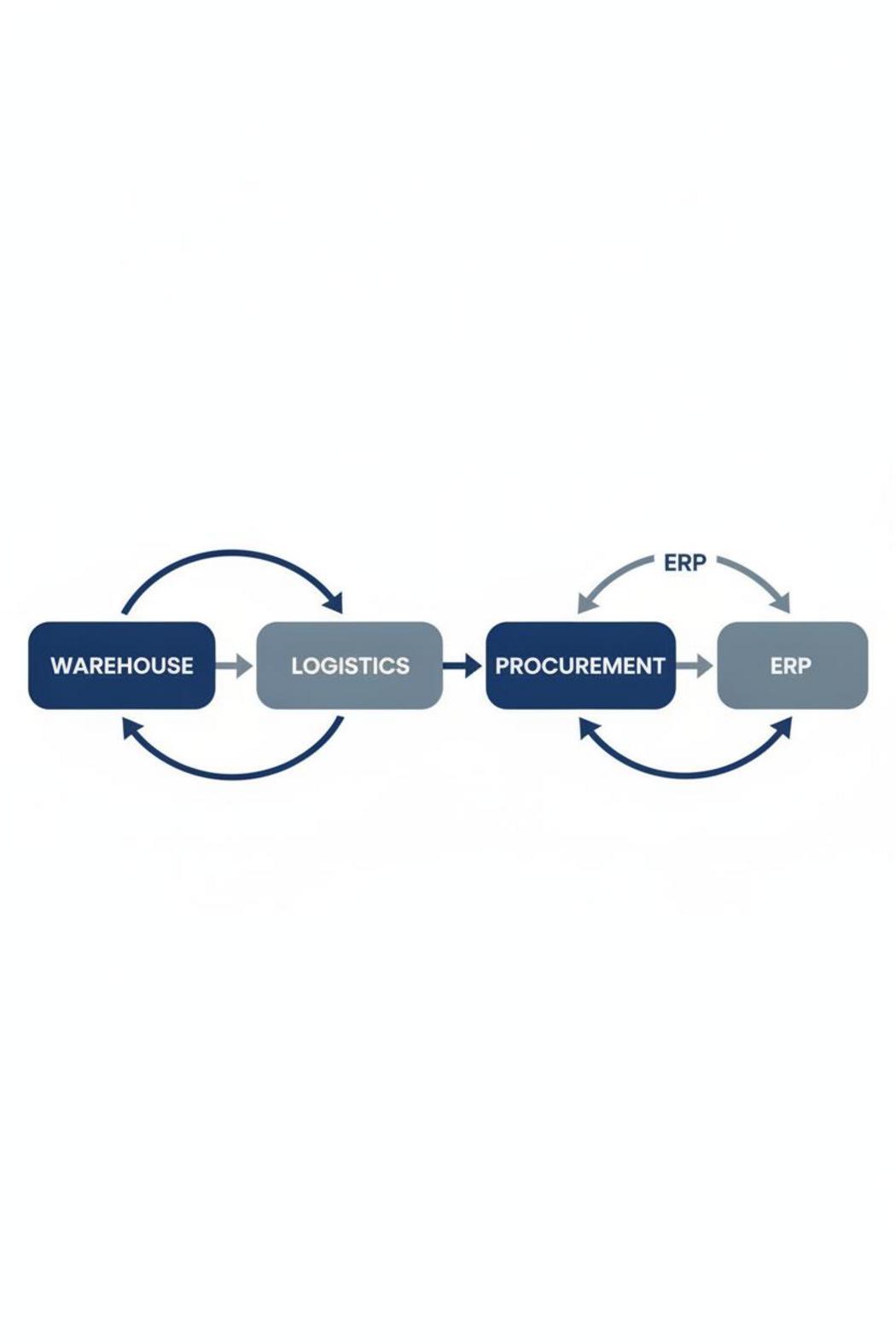
Inventory and demand planning present a slightly different architecture challenge. Here, agentic AI use cases in enterprise 2026 deployments tend to involve multi-agent coordination: one agent class monitors real-time sales velocity and external signals like weather or logistics disruptions, while a second executes reorder logic against ERP systems and a third reconciles discrepancies between warehouse management systems and financial records. The coordination layer — how agents hand off context and resolve conflicts — is where most of the real engineering complexity lives, and it’s also where vendors are currently most differentiated.
It would be a mistake to frame these deployments as purely technical. The organizational friction is significant. Procurement teams accustomed to owning supplier relationships are now supervising agents that initiate those conversations autonomously, which requires both process redesign and a clearer accountability model for agent-driven decisions. The enterprises seeing the most traction have invested seriously in defining agent authority boundaries upfront — what actions require human approval, what audit trails are mandatory, and how agents surface their reasoning in terms that non-technical stakeholders can actually interrogate. Without that governance scaffolding, enterprise automation use cases in supply chain tend to stall at pilot stage, not because the technology fails, but because the organization hasn’t built the trust infrastructure to let it operate at scale.
The throughline across successful deployments is that agentic systems are being introduced not to eliminate supply chain roles but to absorb the high-volume, low-ambiguity decision layer that currently prevents those roles from operating strategically. Whether that framing holds as agent capabilities expand is a legitimate open question — but for now, it’s the architecture delivering measurable ROI.
Conclusion
The enterprises pulling ahead in 2026 are not the ones experimenting with the most agents—they are the ones that have instrumented, constrained, and operationalized a small number of high-leverage agentic workflows with the same rigor they apply to core production services. Agentic AI use cases in enterprise 2026 reward precision over proliferation: defined tool boundaries, observable reasoning traces, human-in-the-loop checkpoints at critical decision nodes, and measurable outcome metrics tied to business value. Pick the workflow with the highest cost-of-failure and highest repetition rate, harden it, and scale from there.
Questions or something we should be covering? Reach out via the Contact page. ⚡