Choosing the best AI agent framework for production is one of the most consequential architectural decisions a team can make in 2026, and the wrong call surfaces quickly under real load. Unlike prototype environments where a framework’s rough edges are tolerable, production workloads expose flaws in error handling, retry logic, state persistence, and observability within days of deployment.
This comparison cuts through marketing claims to examine how LangChain, CrewAI, LlamaIndex Workflows, and AutoGen actually behave when agents run continuously, handle partial failures, and operate inside larger distributed systems. Evaluation criteria include determinism of execution paths, native support for structured outputs, tool-call reliability, latency characteristics, and the maturity of each framework’s tracing and debugging surface — the factors that determine whether a production AI agent stays running or becomes a liability.
What Production Actually Demands from an Agent Framework

🔧 Related tools & reading:
🤖 Building Agent-Powered Applications : Your guide to generative AI, RAG, fine-tuning, and orchestration for production use — $39.99 at eBooks.com
📘 LLM Engineer’s Handbook — $47.99 at Barnes & Noble – NOOK
🚀 LLMs in Production: From Language Models to Successful Products — $48.13 at Target
Before evaluating any specific framework, it’s worth being precise about what “production” actually means in this context — because the term gets thrown around loosely. A production AI agent isn’t a demo that runs cleanly on curated inputs. It’s a system that handles malformed tool responses, recovers from partial failures, operates within rate limits, logs enough state to be debuggable after the fact, and does all of this without requiring an engineer on call to babysit it. Most framework comparisons skip this framing entirely, which is why so many teams end up discovering the hard way that what worked in a notebook falls apart under real operational load.
Reliability is the foundational requirement, and it’s more nuanced than uptime. A production AI agent needs deterministic retry logic, bounded execution loops, and explicit handling for the cases where an LLM returns something structurally unexpected. Frameworks that treat the LLM as an always-cooperative participant tend to build fragile abstractions on top of that assumption. The best ai agent framework for production workloads is one that assumes failure as the default and builds recovery paths into its core execution model — not as an afterthought bolted on through middleware.
Observability is equally non-negotiable. When an agent takes an unintended action or produces a wrong output in production, you need a trace that shows exactly what prompts were constructed, what tools were called, what was returned, and what decision logic fired at each step. Frameworks that abstract too aggressively over these internals — trading visibility for developer convenience — create systems that are fast to prototype but nearly impossible to debug at scale. LangChain production deployments, for instance, have faced real criticism here: the abstraction layers can make it genuinely difficult to understand what’s happening inside a running agent without significant instrumentation overhead added on top.
State management and concurrency handling round out the core requirements. Agents running in production are rarely isolated — they share resources, hit the same downstream APIs, and often need to maintain context across sessions or hand off work between sub-agents. Frameworks that don’t have a coherent model for how state is scoped, persisted, and invalidated tend to produce subtle bugs that only surface under concurrent load. CrewAI deployment scenarios, particularly those involving multi-agent coordination, expose this quickly: if the framework doesn’t give you explicit control over how agents share and isolate context, you’re building on assumptions that will eventually betray you.
None of this is to say that ease of development doesn’t matter — it does. But the frameworks that earn a place in production infrastructure are the ones where the ergonomic choices were made in full awareness of operational constraints, not in spite of them. That distinction separates tools worth evaluating seriously from tools worth using only to validate an idea before rebuilding it on something more durable.
LangChain and LangGraph: Mature Ecosystem, Real Trade-offs
🔧 Related tools & reading:
🤖 Building Agent-Powered Applications : Your guide to generative AI, RAG, fine-tuning, and orchestration for production use — $39.99 at eBooks.com
📘 LLM Engineer’s Handbook — $47.99 at Barnes & Noble – NOOK
🚀 LLMs in Production: From Language Models to Successful Products — $48.13 at Target
LangChain entered the agentic AI space early enough that it effectively defined how many developers first thought about chaining LLM calls together. That legacy is both its greatest strength and its most persistent liability. The ecosystem is genuinely vast — integrations with nearly every major model provider, vector store, and tool layer you’d reasonably encounter in production — and the community documentation has matured considerably since the chaotic early releases. If your team is evaluating the best AI agent framework for production and wants to minimize integration surface area, LangChain’s breadth is a real argument in its favor, not just a marketing claim.
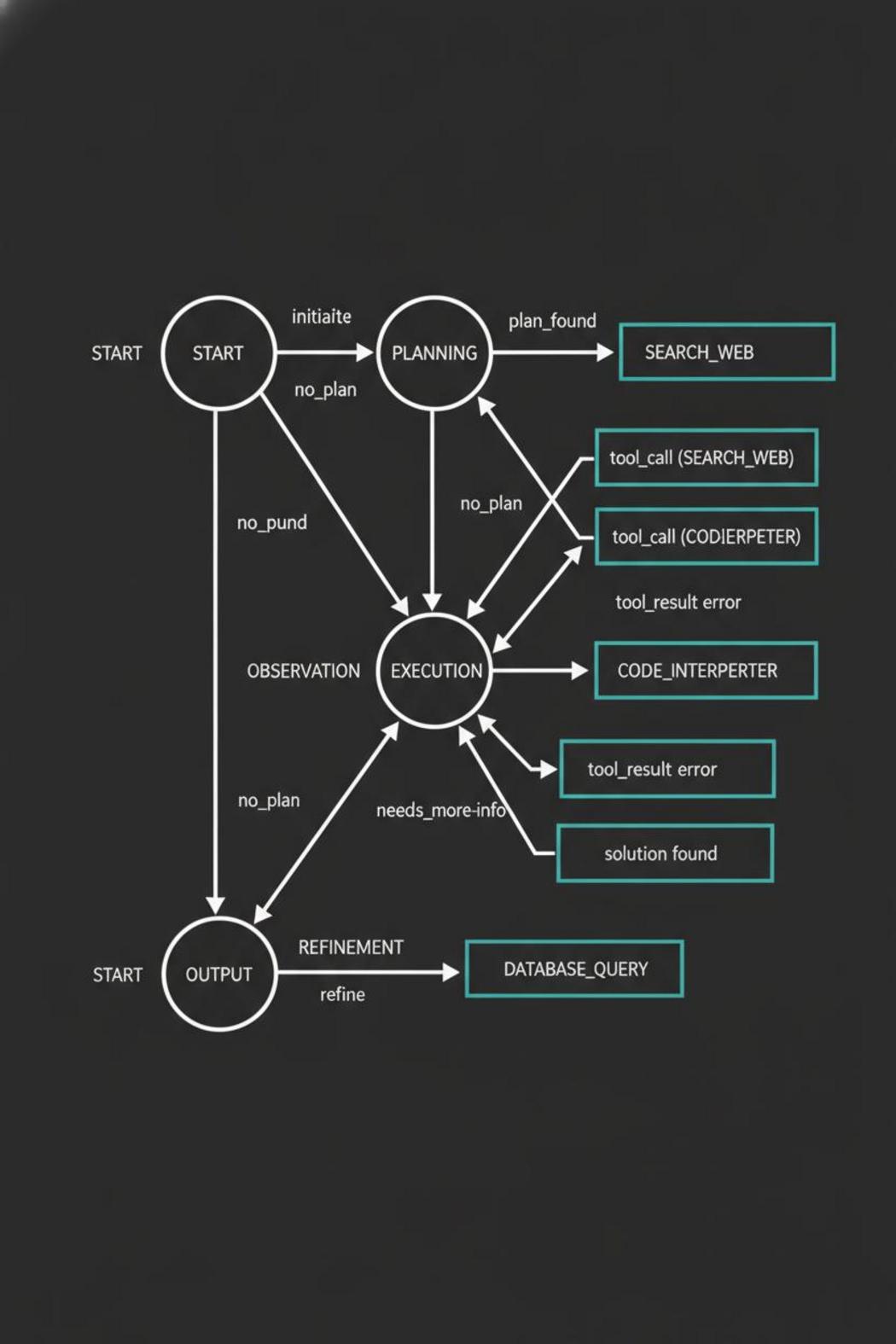
The more serious conversation, however, is about LangGraph. LangChain’s graph-based orchestration layer was a direct response to a real architectural problem: purely linear chains break down fast when agents need conditional branching, cycles, or persistent state across steps. LangGraph models execution as a directed graph with explicit nodes and edges, which gives engineers something they can reason about, debug, and test in isolation. For production AI agent workloads where observability and control flow predictability matter, this is a meaningful design improvement over the original chain abstraction. You can inspect intermediate state, implement human-in-the-loop checkpoints, and handle partial failures without the whole execution collapsing.
That said, the trade-offs are real and shouldn’t be glossed over. LangChain’s abstraction layers have historically leaked — behavior that works cleanly in a notebook can surface unexpected prompting quirks or silent failures when you scale to higher request volumes or swap model providers. The framework has gone through enough API surface changes that production teams maintaining LangChain code over a 12-to-18 month horizon have generally felt the maintenance cost. Agent reliability isn’t just about whether the framework runs; it’s about whether the team can confidently trace a failure to its source. LangChain’s layered abstractions can make that harder, not easier.
LangGraph improves the debuggability story substantially, but it also introduces real complexity. Teams without engineers who are comfortable thinking in graph execution terms will find the mental overhead non-trivial. Compared to something like CrewAI deployment, which optimizes for a faster initial setup around role-based agent collaboration, LangGraph asks more of the developer upfront in exchange for finer-grained control. That trade-off is often the right one for serious production systems — but it has to be made deliberately, not by default. If your workload requires auditable, stateful, multi-step agent behavior with defined recovery paths, LangGraph’s model earns its complexity. If you’re prototyping a collaborative agent pattern and need something running in days, that calculus shifts.
CrewAI Deployment: Multi-Agent Coordination Under Pressure
🔧 Related tools & reading:
🤖 Building Agent-Powered Applications : Your guide to generative AI, RAG, fine-tuning, and orchestration for production use — $39.99 at eBooks.com
📘 LLM Engineer’s Handbook — $47.99 at Barnes & Noble – NOOK
🚀 LLMs in Production: From Language Models to Successful Products — $48.13 at Target
CrewAI has carved out a specific niche in the production AI agent conversation by making multi-agent role assignment feel intuitive — almost deceptively so. The framework lets you define agents with explicit roles, goals, and backstories, then wire them together into crews that execute sequential or hierarchical task pipelines. On paper, and in demos, this works cleanly. Under genuine production load, the picture gets more complicated and worth examining carefully before you commit architectural decisions to it.
The coordination model is where CrewAI either earns its place or exposes its limitations, depending on your workload profile. When agents hand off tasks sequentially, the framework manages context propagation reasonably well — each agent receives prior outputs as part of its prompt context. But this also means token budgets balloon quickly in long pipelines, and there’s limited native tooling to compress or summarize intermediate state before passing it downstream. Teams running CrewAI in production have reported non-trivial cost escalation on complex workflows precisely because context windows fill up with verbose intermediate results rather than distilled signals.
Fault tolerance is the other pressure point. CrewAI doesn’t ship with robust retry logic or granular error handling at the inter-agent boundary out of the box. If one agent in a crew hits a tool failure or returns a malformed response, the default behavior in most configurations is to surface the error upward rather than reroute or degrade gracefully. For a production AI agent handling mission-critical workflows, this means engineering teams typically layer their own exception handling and fallback logic on top of the framework — which adds complexity that partially offsets CrewAI’s ergonomic advantages.
Observability is another area where CrewAI lags behind what serious production environments demand. LangSmith integration exists and covers LangChain-based components, but native tracing across the full crew execution graph — agent-to-agent handoffs, tool invocations, intermediate decisions — requires additional instrumentation work. When you’re debugging a multi-agent failure at 2 AM, the difference between a framework that exposes structured execution traces and one that requires you to reconstruct the call chain from scattered logs is significant. For teams already invested in LangChain production infrastructure, the overlap helps, but it doesn’t fully close the gap.
None of this disqualifies CrewAI as a candidate when evaluating the best AI agent framework for production use. For workloads where multi-agent role semantics genuinely simplify the problem — content pipelines, research orchestration, structured report generation — it delivers real value and moves faster than hand-rolled orchestration. The honest assessment is that CrewAI rewards teams who treat it as a starting scaffold and invest in hardening it, not as a production-ready runtime that works out of the box. That distinction matters a great deal when reliability, cost control, and operational visibility are non-negotiable requirements rather than nice-to-haves.
Observability, Failure Recovery, and the Framework Decision Matrix
🔧 Related tools & reading:
🤖 Building Agent-Powered Applications : Your guide to generative AI, RAG, fine-tuning, and orchestration for production use — $39.99 at eBooks.com
📘 LLM Engineer’s Handbook — $47.99 at Barnes & Noble – NOOK
🚀 LLMs in Production: From Language Models to Successful Products — $48.13 at Target
When evaluating the best AI agent framework for production, most teams fixate on capability benchmarks — how well an agent reasons, how cleanly it handles tool calls. These matter, but they’re not what separates frameworks that survive contact with real workloads from those that collapse quietly and expensively in the background. The differentiating factors are observability depth and failure recovery architecture, and most popular frameworks have made surprisingly different bets on both.
LangChain production deployments benefit from LangSmith’s tracing infrastructure, which gives teams genuine visibility into chain execution, token consumption, and intermediate reasoning steps. That’s not cosmetic — when a multi-step agent silently returns a degraded output because a tool call timed out on step four, you need a trace that shows exactly where the state diverged from expectation. Without that, debugging becomes archaeological work through logs that weren’t designed to tell the story you need. LangGraph extends this further by making execution state explicit and persistent, which means recovery from mid-run failures isn’t just theoretically possible — it’s a first-class design primitive.
CrewAI deployment at scale presents a different picture. The framework’s role-based abstraction speeds up development significantly, but its observability story remains thinner than teams running stateful, long-horizon tasks typically require. There’s no native equivalent to LangSmith’s trace depth, and when agent crews fail partway through a workflow, the recovery options depend heavily on how much state management the developer has wired in manually. That’s not a fatal flaw — it’s an architectural tradeoff that makes CrewAI genuinely well-suited for bounded, well-specified pipelines where failure modes are limited and retries are acceptable. It’s a liability in agentic workloads where partial completion carries real cost.
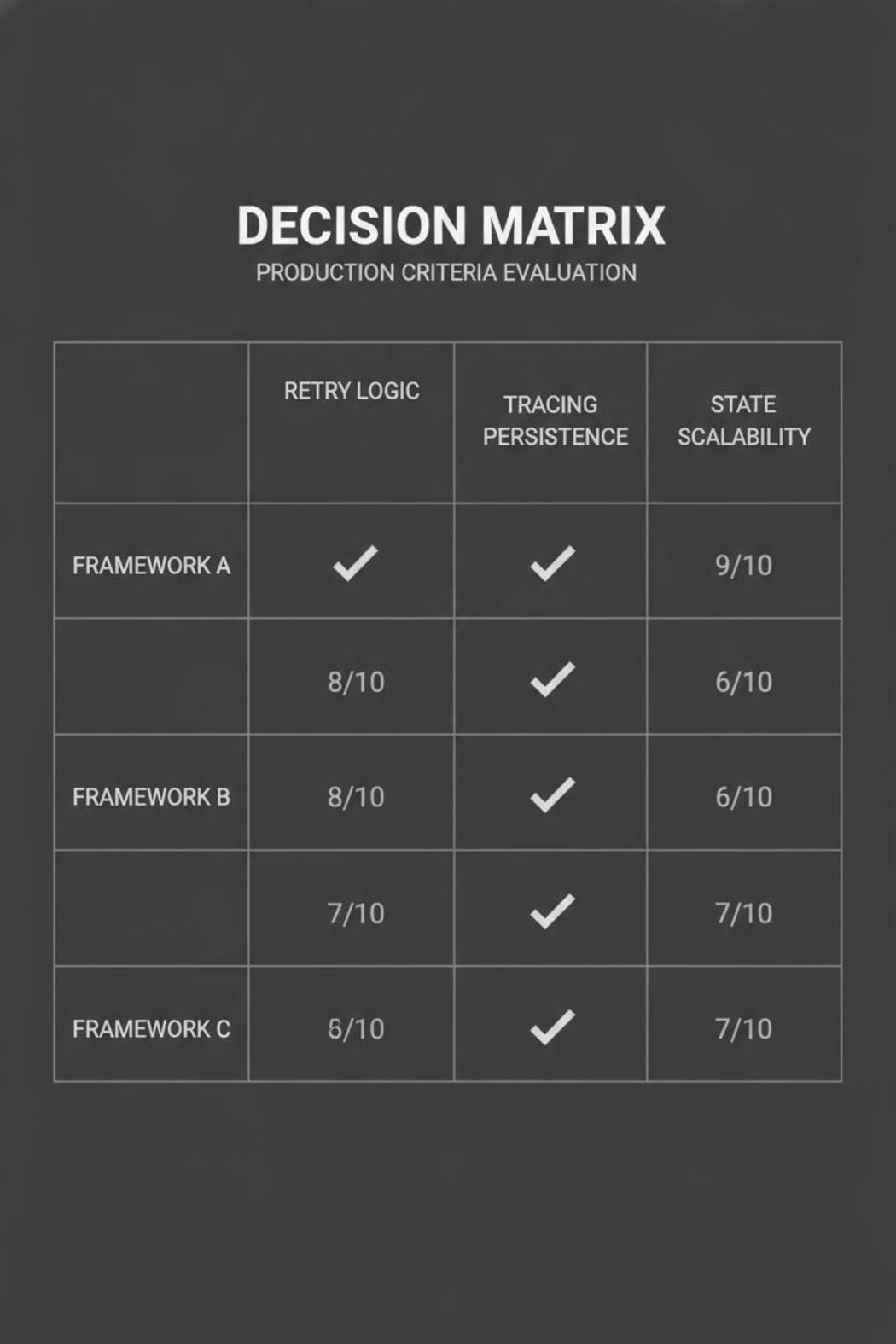
The practical decision matrix here isn’t about which framework is objectively superior — it’s about matching failure tolerance requirements to what each framework actually provides. If your production AI agent operates over long horizons, touches external systems with side effects, or needs to resume from interruption rather than restart from scratch, the observability and state management capabilities of your framework aren’t optional extras. They’re load-bearing architecture. Frameworks built around stateless, ephemeral execution patterns force you to reconstruct that infrastructure yourself, which teams routinely underestimate in both effort and ongoing maintenance cost.
The honest answer is that no current framework handles all of this cleanly. LangGraph offers the most sophisticated state and recovery primitives but carries meaningful complexity overhead. AutoGen’s conversation-centric model simplifies certain multi-agent coordination patterns but makes fine-grained observability harder to instrument. The selection decision, done properly, starts with a written failure taxonomy specific to your workload — what fails, how often, at what cost — and works backward to which framework’s architecture makes those failure modes tractable. Teams that skip this step tend to discover the gaps six weeks after their first production incident.
Conclusion
No single framework wins every production scenario, but understanding where each one breaks is the only way to make a defensible architectural choice. Selecting the best AI agent framework for production requires stress-testing your assumptions around latency budgets, failure recovery, observability hooks, and team operational maturity before a single line of agent code reaches your pipeline. Map your workload constraints first, then let those constraints eliminate frameworks rather than chasing feature lists. The right choice is the one your team can debug at 2 a.m.
Questions or something we should be covering? Reach out via the Contact page. ⚡