Every new autonomous AI agent assistant launched in 2026 is arriving with a sharper set of architectural assumptions than its predecessors — longer context windows, tighter tool-use scaffolding, and explicit memory management replacing the ad hoc hacks that defined early agentic stacks.
This breakdown covers the most significant agentic AI product releases of the year, evaluated on criteria that matter to builders: how each agent handles multi-step planning, what tool-calling protocols it exposes, how it manages state across sessions, and where failure modes tend to cluster in production.
We are not cataloguing demos. Every agent included here has either shipped an API, a hosted runtime, or an open-source release that engineers can deploy against. Where benchmarks exist, we cite them. Where they do not, we describe observed behavior under documented test conditions.
Architecture Patterns Behind the 2026 Agent Wave

🔧 Related tools & reading:
🤖 Building LLM Powered Applications — $49.99 at World of Books
🧠 Building LLM Applications: A developer’s guide to creating intelligent AI systems — $28.00 at Walmart
⚙️ Building effective LLM-based applications with Semantic Kernel — $24.99 at Walmart
The architectural choices underlying the current wave of agentic AI product releases are more consequential than the feature announcements themselves. What’s notable about the most significant new autonomous AI agent assistant launches of 2026 isn’t the marketing framing — it’s the convergence on a small set of design patterns that have quietly become the industry’s working consensus after years of fragmented experimentation. Understanding those patterns is the only way to evaluate whether a given system is genuinely capable or simply dressed up in agentic language.
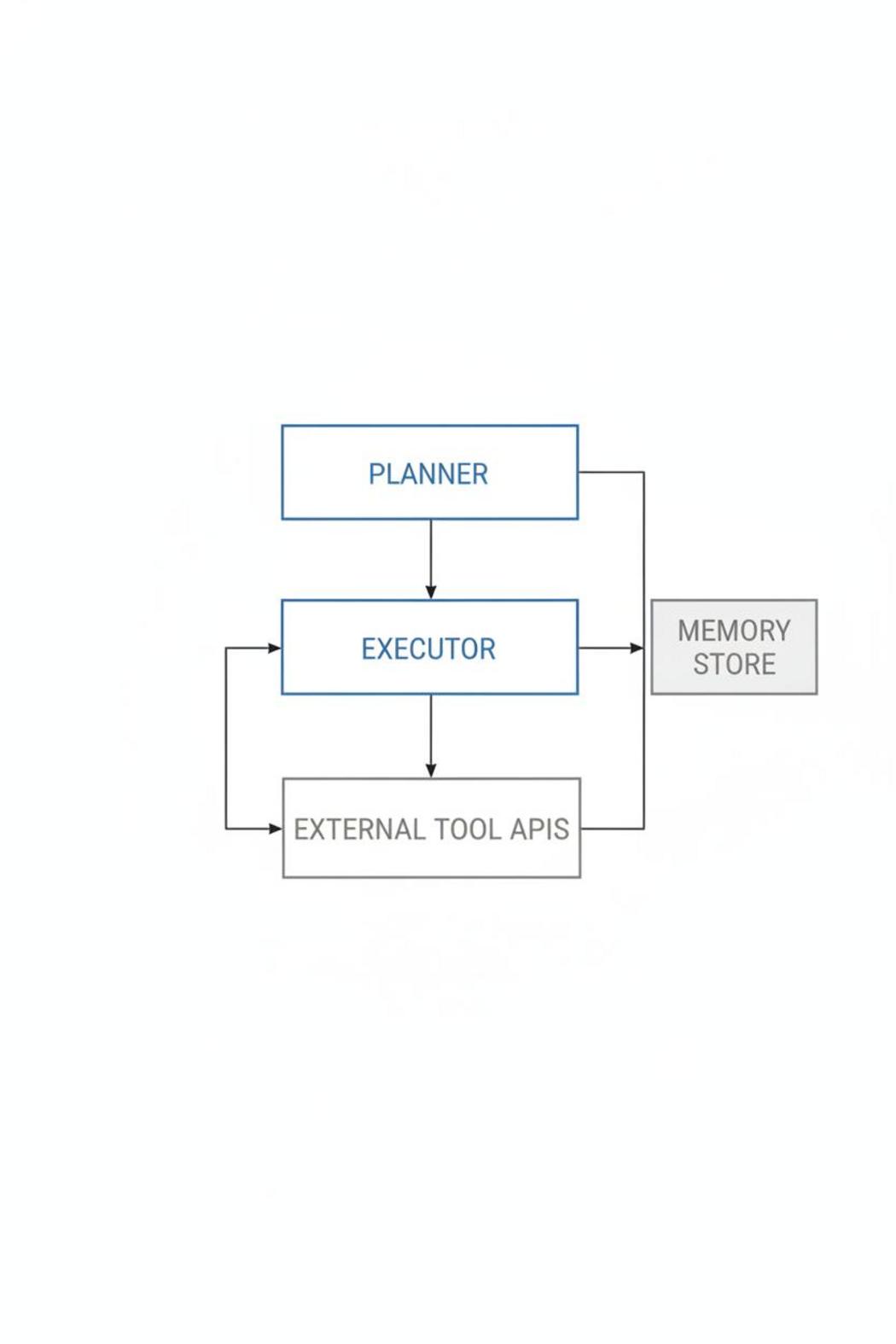
The dominant pattern this year is what practitioners are calling the “orchestrator-executor” split: a planning layer that reasons about task decomposition and sequencing, separate from the execution layer that actually calls tools, retrieves context, and writes outputs. The 2024 and 2025 generation largely conflated these responsibilities into a single model pass, which produced brittle behavior under task complexity. The cleaner separation now allows teams to swap or fine-tune each layer independently, and it creates more legible failure modes — a critical requirement for any autonomous assistant operating in production environments with real consequences.
Memory architecture has also matured considerably. Earlier agent releases leaned almost entirely on context-window stuffing, which scaled poorly and degraded reasoning quality on longer horizons. The 2026 cohort of agentic AI products more commonly implements tiered memory: short-term working context, session-scoped episodic storage, and longer-lived semantic retrieval over external knowledge bases. The retrieval mechanisms themselves have gotten more sophisticated — rather than simple embedding similarity, several systems now use structured indexing and recency weighting to surface genuinely relevant information rather than merely similar text.
Tool use and environment interaction have shifted from being add-ons to being first-class architectural concerns. Agent releases that are generating the most serious enterprise interest are those designed around tool schemas from the ground up, rather than systems that bolt on function-calling as an afterthought. The distinction matters operationally: agents built around structured tool interfaces handle ambiguous or underspecified instructions more gracefully, because the tool boundary forces explicit representation of what the system knows versus what it needs to retrieve or compute.
Finally, the reliability engineering layer — eval pipelines, guardrails, rollback mechanisms — is increasingly visible in how vendors describe their systems, which itself reflects how the space has shifted. A year ago, most AI agent launch announcements led with capability benchmarks. Today, the technically credible ones lead with observability and intervention surfaces. That shift in emphasis doesn’t make the underlying models more capable, but it does make the systems more deployable, which is a different and arguably more important metric for organizations trying to move beyond pilots into actual workflows.
Major AI Agent Launches of 2026: Capabilities Compared
🔧 Related tools & reading:
🤖 Building LLM Powered Applications — $49.99 at World of Books
🧠 Building LLM Applications: A developer’s guide to creating intelligent AI systems — $28.00 at Walmart
⚙️ Building effective LLM-based applications with Semantic Kernel — $24.99 at Walmart
The first half of 2026 has produced a meaningful cluster of agentic AI product releases, several of which represent genuine architectural shifts rather than incremental capability bumps. What distinguishes this wave from earlier assistant-style systems is the degree to which these agents operate across extended task horizons with minimal human checkpoints — a structural change that carries real implications for how enterprises and developers think about workflow automation and oversight.
Among the most technically substantive releases is Anthropic’s expanded Claude Agentic layer, which introduced formalized tool-use planning with explicit state tracking across multi-step processes. Unlike earlier implementations where tool calls were essentially reactive, the new architecture allows the agent to maintain and revise a task graph mid-execution, backtracking when intermediate outputs fall outside expected ranges. This kind of self-corrective looping was previously handled externally by orchestration frameworks; it’s now partially internalized. Every new autonomous AI agent assistant 2026 release worth examining has had to contend with this question of where reasoning lives — inside the model or in surrounding scaffolding — and Anthropic has made a deliberate architectural bet here.
OpenAI’s continued development of Operator-class agents and the broader GPT-5-based agentic stack has emphasized persistent memory and cross-session context as the differentiating layer. The practical effect is an autonomous assistant that can maintain project-level awareness across days or weeks, rather than resetting at session boundaries. This sounds mundane until you consider the compounding failure modes it introduces: stale context, conflicting instructions, and memory poisoning are now production-grade concerns rather than theoretical edge cases. The AI agent launch cadence from OpenAI this year has been fast enough that evaluation frameworks are visibly lagging behind deployment.
Google DeepMind’s Gemini-based agent releases have leaned heavily into multimodal reasoning pipelines, with particular emphasis on agents that can interpret and act on visual environment states — browser UIs, document layouts, structured data in image form. This positions their agentic AI product line closer to computer-use paradigms than pure language-task automation. Meanwhile, a set of well-funded startups including Cognition (Devin’s successors), Emergence, and several stealth-mode labs have shipped systems targeting narrower vertical domains: legal document workflows, software engineering pipelines, and scientific literature synthesis. These vertical agents frequently outperform general-purpose systems on their target tasks precisely because they trade breadth for depth in their reasoning scaffolding and tool ecosystems.
Across all of these agent releases, a few consistent technical tensions have emerged: the tradeoff between agent autonomy and auditability, the unresolved problem of reliable failure detection in long-horizon tasks, and the challenge of grounding agent actions in consistent permission and access models. The 2026 landscape is not short on capability — it is short on the kind of principled evaluation infrastructure that would let practitioners make honest comparisons between systems. That gap, more than any individual product announcement, is the defining constraint on where agentic AI actually lands in production environments this year.
Memory, State Management, and Tool-Use in Production

🔧 Related tools & reading:
🤖 Building LLM Powered Applications — $49.99 at World of Books
🧠 Building LLM Applications: A developer’s guide to creating intelligent AI systems — $28.00 at Walmart
⚙️ Building effective LLM-based applications with Semantic Kernel — $24.99 at Walmart
The most telling indicator of maturity in any new autonomous AI agent assistant 2026 release isn’t the demo reel — it’s how the system handles memory degradation, state drift, and tool failure mid-task. This year’s cohort of agent launches has forced a more serious conversation about what production-grade agentic infrastructure actually requires, and the gap between marketing claims and architectural reality remains wider than most vendors would prefer to acknowledge.
Memory architecture has emerged as the sharpest dividing line between serious deployments and prototype-tier products. Short-term working memory, implemented through extended context windows, is now nearly universal — but context alone doesn’t constitute memory. The more consequential distinction is between systems that treat memory as ephemeral scratchpad versus those building explicit episodic stores with retrieval layers, allowing agents to reference prior task states across sessions. A handful of agentic AI product releases this year have shipped with hybrid architectures that combine vector-based semantic retrieval with structured episodic logs, though few have published benchmarks rigorous enough to evaluate retrieval fidelity under real workload conditions.
State management is where most production deployments have encountered their hardest friction. Long-horizon tasks — anything requiring more than a handful of sequential decisions — expose a fundamental tension: agents need to maintain coherent internal representations of where they are in a workflow while simultaneously adapting to stochastic tool outputs and environmental changes. Several agent release announcements this year have introduced explicit state schemas, essentially typed representations of task progress that survive interruptions and can be inspected or corrected by human operators. This is a meaningful architectural step, even if the implementations remain brittle under edge-case conditions.
Tool-use reliability has seen genuine but uneven progress. The ability to chain tool calls conditionally — invoking a secondary API based on the structured output of a first — is increasingly common. What remains inconsistent is graceful degradation: how an agent behaves when a tool returns an unexpected schema, times out, or returns a plausible-but-incorrect result. The better-engineered systems in this year’s autonomous assistant landscape have introduced tool validation layers and retry logic with exponential backoff, borrowing patterns long established in distributed systems engineering. The weaker ones still surface raw tool failures to the language model layer and hope for the best, which is not a production strategy — it’s an optimism strategy.
Taken together, the 2026 release cycle has clarified which teams actually understand the operational demands of agentic systems at scale. Memory, state, and tool-use aren’t peripheral concerns that can be patched in post-launch — they’re load-bearing architectural decisions that determine whether an agent can be trusted outside a controlled demo environment. The products that have gotten this right share a common thread: they were built by people who had already watched earlier implementations fail in production, and designed accordingly.
Deployment Models and What Builders Should Evaluate First

🔧 Related tools & reading:
🤖 Building LLM Powered Applications — $49.99 at World of Books
🧠 Building LLM Applications: A developer’s guide to creating intelligent AI systems — $28.00 at Walmart
⚙️ Building effective LLM-based applications with Semantic Kernel — $24.99 at Walmart
Before committing to any new autonomous AI agent assistant launched in 2026, builders need to think carefully about deployment architecture before they think about capability claims. The two dominant models this year remain cloud-hosted managed runtimes — where the vendor controls execution infrastructure, memory persistence, and tool access — and self-hosted or hybrid deployments where the builder retains control over the execution environment. Neither is categorically superior, but the tradeoffs are significant enough that choosing the wrong one early creates compounding friction as systems scale.
For teams evaluating a cloud-managed agentic AI product, the first question isn’t feature parity — it’s data residency and execution transparency. When an agent is invoking tools, calling external APIs, or operating on sensitive documents, you need a clear audit trail of what ran, when, and with what permissions. Several of the more prominent agent releases this year have improved their logging interfaces considerably, but observability remains inconsistent across providers. If a vendor can’t give you structured, queryable execution logs without routing through a third-party integration, that’s a meaningful gap for any production deployment.
Self-hosted frameworks offer more control but introduce their own evaluation surface. The critical variables are cold-start latency under concurrent workloads, how gracefully the system handles partial tool failures mid-task, and whether the memory layer — episodic, semantic, or both — can be isolated per user or per workflow without significant configuration overhead. Several autonomous assistant frameworks released this year have made meaningful progress on multi-tenant memory isolation, but the documentation often lags behind the actual implementation, which means builders are still doing more empirical testing than they should need to.
Regardless of deployment model, the evaluation criteria that consistently separates robust systems from brittle ones comes down to interrupt handling and recovery semantics. An agent that fails cleanly, surfaces its failure state accurately, and resumes from a coherent checkpoint is far more production-ready than one with broader nominal capability but opaque failure modes. Too many teams anchor their evaluation on benchmark task success rates and underweight the operational behavior when things go wrong — which, in real workloads, they will. With the volume of AI agent launches this year accelerating, the noise-to-signal ratio in vendor positioning is high. Grounding your evaluation in these structural questions before engaging with feature roadmaps is the more defensible approach.
Conclusion
The 2026 agent release cycle has moved the baseline forward, but the gap between a compelling demo and a reliable production deployment remains the defining challenge for every team building on these systems. Every new autonomous AI agent assistant launched in 2026 ships with stronger reasoning, tighter tool integration, and improved memory architectures — yet latency, failure recovery, and trust boundaries still demand rigorous engineering before any system goes live at scale. Evaluate capabilities critically, stress-test edge cases early, and treat vendor benchmarks as a starting point, not a finish line.
Questions or something we should be covering? Reach out via the Contact page. ⚡